One of the first questions almost every new investor asks is simple: “Should I start SIP or invest lumpsum?” Most people expect a straightforward formula. Markets are down, so invest lumpsum. Markets are high, so do SIP. The problem is that real investing rarely works that neatly. The standard answer floating around online sounds intelligent, but it ignores something far more important than market theory: human behaviour. In practice, the better investment method is usually the one a person can continue calmly for years without second-guessing themselves every month.
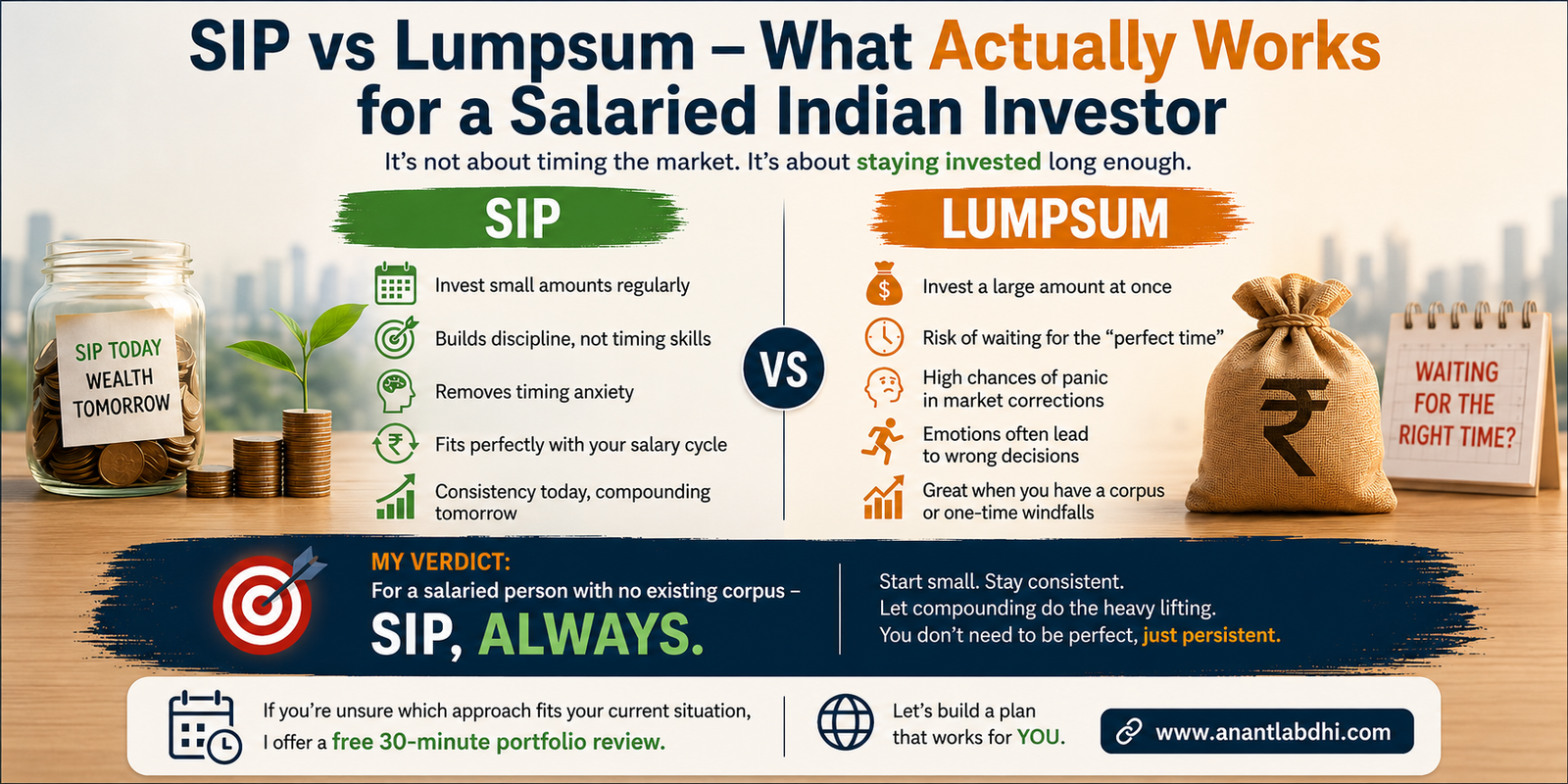
SIP works because it fits real life. Salaried people earn monthly, spend monthly, and save monthly. A SIP quietly converts that monthly surplus into long-term wealth without demanding constant decisions. People talk about rupee cost averaging as if investors sit with spreadsheets calculating averages every quarter. That is not what changes lives. What actually matters is consistency. SIP removes the pressure of predicting markets. You do not wake up every morning wondering whether Nifty will crash next week. You simply continue investing. Over time, that routine becomes automatic, and that is where the real power lies. Investors who stay invested for ten or fifteen years usually do well, not because they were market experts, but because they kept going through both excitement and fear.
That does not mean lumpsum investing is wrong. There are situations where it makes complete sense. If someone receives an annual bonus, inheritance money, maturity proceeds from an FD, or sells a property, keeping large idle cash in a savings account for years is usually a bigger mistake than market volatility. The biggest trap is waiting endlessly for the “perfect entry point.” I have seen investors sit on cash during bull markets expecting a correction, only to watch markets move much higher. Then, when the correction finally comes, fear prevents them from investing anyway. Timing sounds smart in theory. Emotionally, it is extremely difficult in real life.
Over the last decade, one pattern has repeated itself again and again in my experience. SIP investors generally survive market corrections far better than lumpsum investors, especially first-time investors. I remember one client who started a modest SIP during uncertain market conditions. He was not excited about markets, did not track business news daily, and honestly knew very little about investing. But the SIP continued every month without interruption. Years later, that disciplined investing created a meaningful corpus almost accidentally.
I have also seen the opposite behaviour many times. During weak or sideways markets, some investors stop their SIPs because they feel markets are “going nowhere” or fear further downside. Months later, when markets recover sharply and headlines turn positive again, the same investors try restarting SIPs at much higher levels. In reality, they miss the most valuable phase of SIP investing. Rupee cost averaging works best when markets are dull, fearful, or falling because more units get accumulated during that period. One investor had paused his SIP during a correction because daily losses made him uncomfortable. By the time he regained confidence, markets had already recovered significantly. He did not lose because of bad funds. He lost because emotions interrupted discipline.
On the other side, I have also seen people invest large amounts during strong market rallies because everyone around them was making money. The first sharp correction immediately created panic. One investor exited nearly his entire portfolio after a market fall because he could not emotionally tolerate seeing losses on a large lumpsum investment. The market recovered later, but he never fully returned with confidence. The damage was not financial alone. It permanently affected his trust in investing itself.
That is why my view on this topic is direct. For a salaried person with no large existing corpus, SIP is usually the better approach. Not because it gives magical returns, but because it gives stability. It creates investing discipline without emotional exhaustion. Most salaried investors do not fail because markets disappoint them. They fail because they stop midway, panic during corrections, or keep delaying decisions while waiting for certainty. SIP solves many of those problems quietly in the background. Once a meaningful corpus is built over time, lumpsum investing can become part of the strategy later. But at the beginning, consistency matters far more than cleverness.
Investing does not reward the smartest prediction every year. It rewards the person who stayed invested long enough for compounding to work. That sounds simple, but very few people actually do it.
If you’re unsure which approach fits your current situation, I offer a free 30-minute portfolio review.
Visit AnantLabdhi contact page to connect.