Most investors do not lose money because they picked terrible mutual funds. They lose because they make a few predictable mistakes at the wrong time. After working with investors for more than a decade, I have noticed that the same patterns repeat again and again. The good news is that most of these mistakes are completely avoidable.
Mistake 1: Stopping SIP During Market Corrections
In my previous article, “SIP vs Lumpsum — What Actually Works for a Salaried Indian Investor,” I argued that SIP’s biggest advantage is not mathematics. It is behaviour. The ability to keep investing when markets make you uncomfortable is what creates long-term wealth.
Unfortunately, many first-time investors do the exact opposite.
They start SIPs enthusiastically when markets are rising, but the moment a correction arrives, fear takes over. They stop their SIPs and decide to “wait until things become clear.”
The problem is that markets are never clear at the bottom. By the time confidence returns, markets have often recovered significantly.
I remember an investor who paused his SIP after seeing his portfolio fall for three consecutive months. Every week he would call and ask whether markets could fall another 10% or 15%. He stopped investing and waited. Nearly eight months later, after markets had recovered sharply, he restarted the same SIP. He did not avoid risk. He simply missed the opportunity to buy at lower prices.
Another investor continued his SIP throughout the same period without making any changes. When markets recovered, he had accumulated significantly more units at lower NAVs. The difference was not intelligence or fund selection. It was discipline.
What should you do instead?
Continue your SIP through corrections. The uncomfortable periods are often when rupee cost averaging works best. Market declines are not a signal to stop investing. They are the periods that help long-term investors accumulate more units.
Mistake 2: Chasing Last Year’s Top Performing Fund
Many investors select funds the same way people choose winning stocks. They look at last year’s return rankings and invest in whichever fund delivered the highest returns.
Unfortunately, yesterday’s winner is not always tomorrow’s winner.
A fund that delivered exceptional returns may have benefited from a specific market cycle, sector trend, or investment style that may not repeat.
I remember an investor who wanted to switch his entire portfolio into a fund that had delivered over 40% returns in the previous year. The fund was heavily exposed to sectors that had already experienced a strong rally. Within the next year, those sectors cooled down and the fund’s performance became average. He was disappointed, not because the fund was bad, but because he expected last year’s performance to continue indefinitely.
Another investor stayed invested in a diversified fund that was not topping the charts every year. Ten years later, his wealth creation was significantly better because he remained consistent rather than constantly chasing winners.
What should you do instead?
Choose funds that match your goals, risk profile, and investment horizon. Consistency of performance, fund management quality, and portfolio strategy matter far more than being number one for a single year.
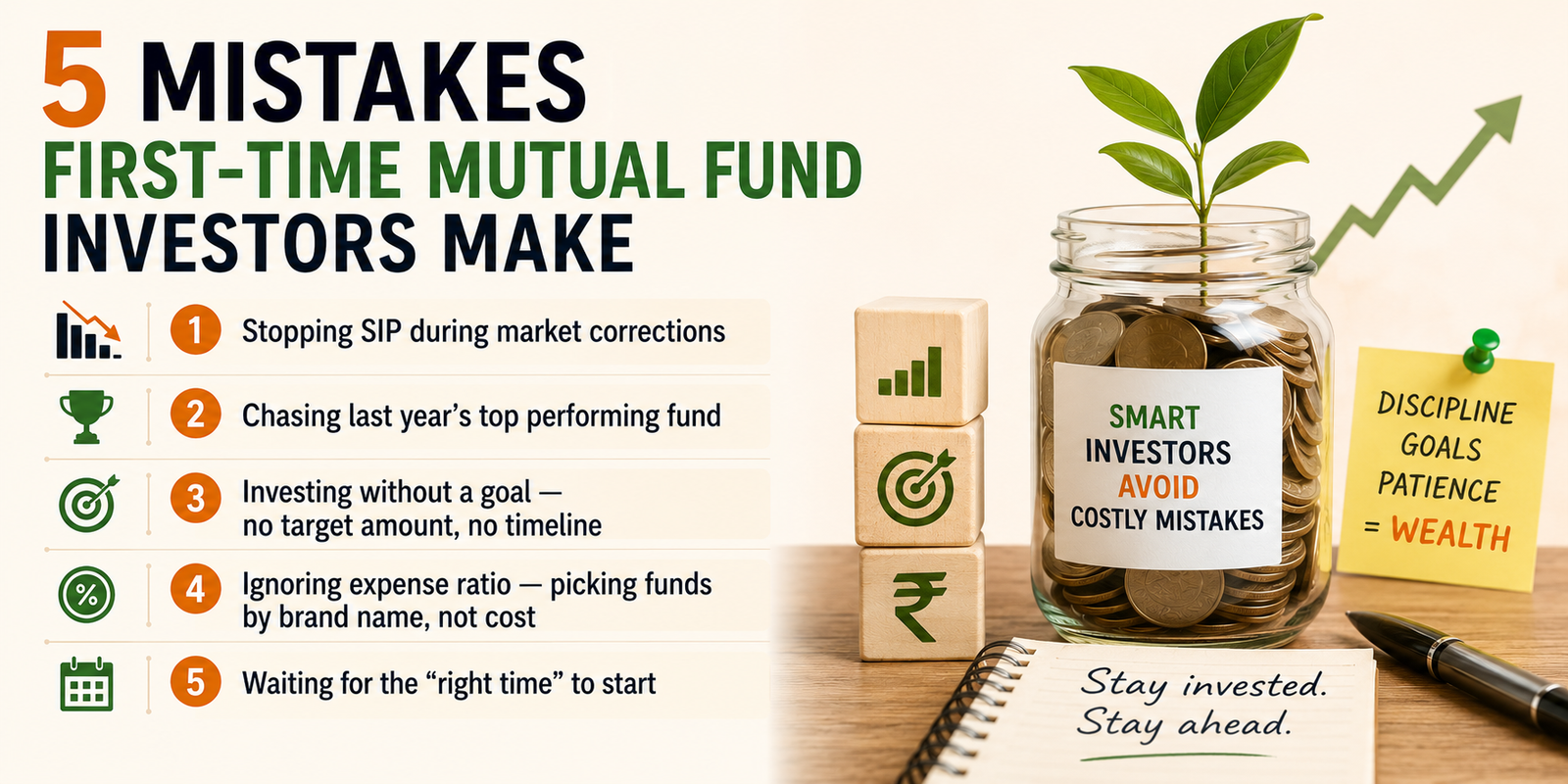
Mistake 3: Investing Without a Goal
Many people start investing simply because someone told them they should. They begin a SIP, but they have no idea what the money is meant to achieve.
No target amount. No timeline. No purpose.
Without a goal, investors become impatient. They check returns constantly and compare themselves with others.
I once reviewed the portfolio of a client who had investments spread across eight different mutual funds. When I asked what the investments were meant for, he paused and admitted he wasn’t sure. Some SIPs had been started because of a friend’s recommendation, some because of social media posts, and others because a bank representative suggested them.
As a result, he frequently redeemed investments whenever he wanted money for discretionary expenses because there was no specific purpose attached to the portfolio.
In contrast, another investor clearly separated investments for retirement, his daughter’s education, and a future home purchase. During market corrections, he remained calm because he was focused on long-term goals rather than short-term returns.
What should you do instead?
Every investment should have a destination. Whether it is retirement, a child’s education, a home purchase, or financial independence, define the goal first and select investments that support it.
Mistake 4: Ignoring Expense Ratio
Many first-time investors focus only on fund house brands, star ratings, or recent returns. Very few pay attention to the expense ratio.
The reality is that even within the same category, expense ratios can vary significantly. For example, two large-cap funds may follow similar investment mandates, yet one may charge 0.70% while another charges close to 2.00%.
At first glance, the difference appears insignificant. After all, what is 1% per year? But investing is a long-term game. Over 15 or 20 years, that seemingly small difference can quietly reduce your final corpus by several lakhs of rupees.
I recently reviewed a portfolio where an investor was holding a large-cap fund with an expense ratio close to 1.8%. When compared with other established large-cap funds in the same category, there were alternatives charging less than half that amount. He had selected the fund purely because of the fund house’s reputation and had never looked at the annual cost.
Another investor regularly reviewed costs during portfolio reviews. Over time, he was able to keep expenses under control without compromising on portfolio quality. The difference may not be visible in a single year, but over decades, lower costs leave more money invested and compounding.
What should you do instead?
Never select a fund based solely on brand name or past returns. When comparing funds within the same category, look at performance consistency, portfolio strategy, fund manager track record, and expense ratio together. A small annual saving in cost can create a surprisingly large difference in wealth over the long run.
Mistake 5: Waiting for the “Right Time” to Start
This mistake prevents more people from building wealth than any market correction ever could.
Many investors spend months, sometimes years, waiting for the perfect entry point. They want markets to fall before they begin investing. Then markets rise. They wait for a correction. When the correction finally comes, fear keeps them on the sidelines.
Meanwhile, time passes.
A young salaried professional once approached me to start a ₹10,000 monthly SIP. After reading several market forecasts online, he decided to wait for a correction. Six months later, markets were higher and he was still waiting. A year later, he finally started the same SIP amount. The real loss was not market returns. It was the twelve months of compounding he gave up while searching for certainty.
I have also seen investors keep money parked in savings accounts earning modest returns while repeatedly saying, “I’ll invest after the next correction.” In many cases, the correction arrives, but fear prevents them from investing anyway.
What should you do instead?
Start with an amount you are comfortable investing today. You can always increase your SIP later. The biggest advantage in investing is not perfect timing. It is giving compounding more time to work.
Final Thoughts
Successful investing is usually less about finding the perfect mutual fund and more about avoiding simple behavioural mistakes. Investors who stay invested during corrections, focus on goals, control costs, and avoid market timing generally build wealth more consistently than those searching for shortcuts.
The market rewards discipline far more often than it rewards prediction.
If you’re unsure whether your current portfolio is aligned with your financial goals, I offer a free 30-minute portfolio review.
Visit AnantLabdhi contact page to connect.