One of the biggest myths in investing is that there is a “best mutual fund” for everyone.
Almost every week, someone asks me, “Which mutual fund should I invest in right now?” The expectation is usually that there is one fund outperforming all others and that finding it is the key to successful investing.
The reality is very different.
The right mutual fund for a 25-year-old software engineer, a 40-year-old parent planning for a child’s education, and a 60-year-old retiree could be completely different. Choosing a mutual fund is not about finding the best fund. It is about finding the right fit for your goals, timeline, and risk tolerance.
In my previous article, SIP vs Lumpsum — What Actually Works for a Salaried Indian Investor, I discussed how investor behaviour matters more than market timing. In the second article, 5 Mistakes First-Time Mutual Fund Investors Make, we looked at common mistakes such as chasing top-performing funds and investing without a goal. This article builds on those lessons and provides a simple framework for selecting the right mutual fund.
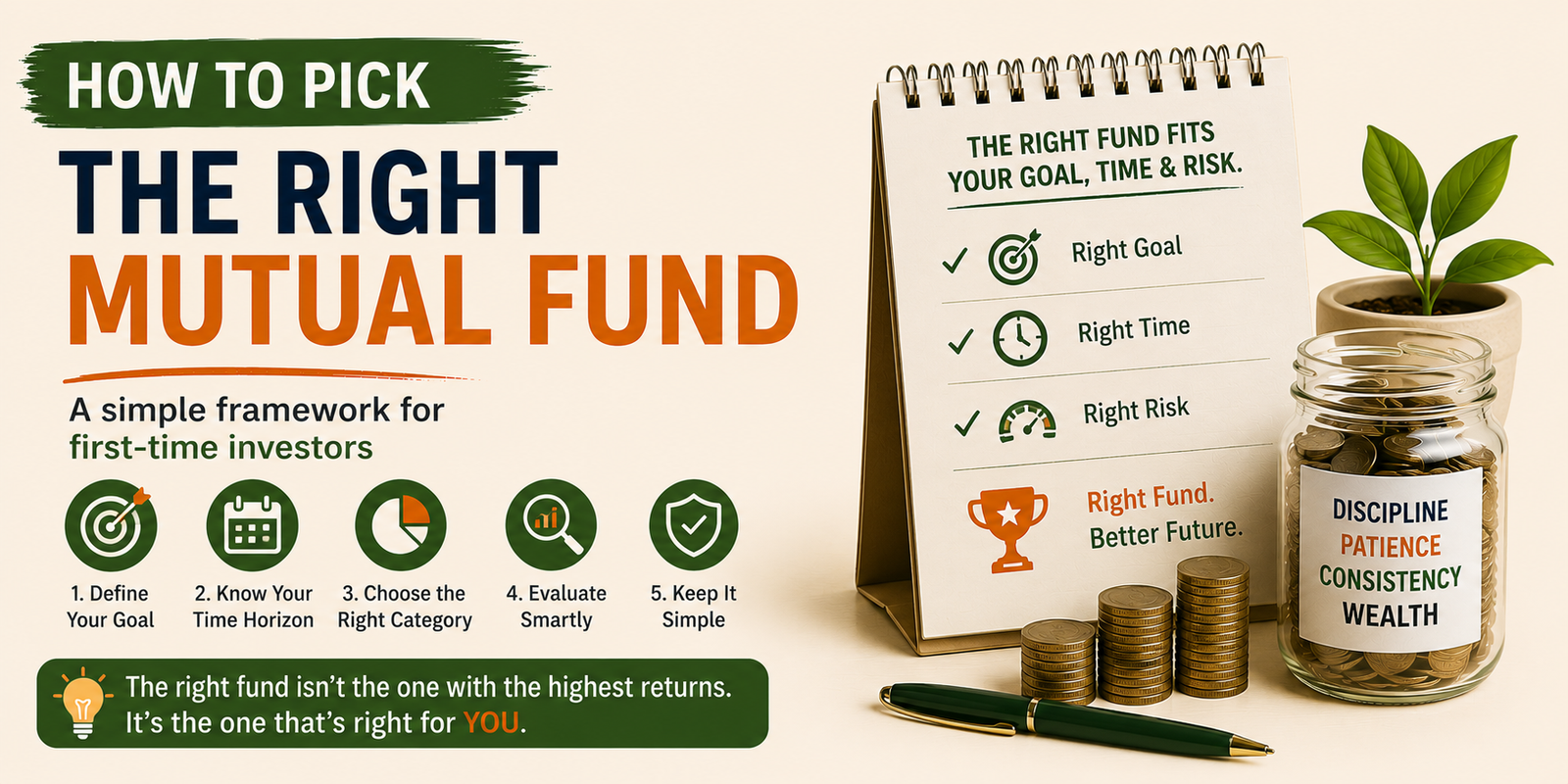
Step 1: Start With Your Goal, Not the Fund
Most investors begin by looking at returns.
That is the wrong starting point.
Before selecting any mutual fund, answer three questions:
- What is this money meant for?
- When will I need it?
- How much money will I need?
The answers determine almost everything else.
For example:
- A 30-year-old planning retirement may have a 25-year investment horizon.
- A parent saving for a child’s higher education may have 10 to 15 years.
- Someone planning a home purchase may need the money within five years.
I once met an investor who had accumulated investments across seven different mutual funds. When I asked what the investments were for, he simply said, “Wealth creation.” There was no specific goal attached to any investment. As a result, he frequently redeemed units for vacations, gadgets, and other short-term expenses.
Another client linked every investment to a specific objective. Even during market corrections, he stayed invested because he knew exactly what each portfolio was meant to achieve.
Goals create discipline. Without goals, every market fluctuation feels important.
Step 2: Match the Fund Category to Your Time Horizon
Once the goal is clear, the next step is selecting the appropriate category of fund.
A simple framework works well for most investors:
- Less than 3 years: Debt or liquid-oriented funds
- 3 to 7 years: Hybrid funds
- More than 7 years: Equity funds
Many investors get into trouble because they take either too much risk or too little risk.
I remember an investor who was saving for a home purchase planned within two years. Unfortunately, he invested most of the money in aggressive mid-cap funds after seeing strong recent returns. A market correction arrived just when he needed the money. He eventually postponed the purchase because the portfolio value had fallen significantly.
The problem was not the mutual fund.
The problem was using the wrong vehicle for the goal.
Time horizon should always determine the level of risk you take.
Step 3: Look Beyond Past Returns
This is where most beginners go wrong.
In the previous article on common investor mistakes, I discussed how many investors chase last year’s top-performing fund. It remains one of the most expensive mistakes investors make.
A fund that delivered outstanding returns over the last year is not guaranteed to repeat that performance.
Markets change. Sectors rotate. Styles go in and out of favour.
One investor I worked with reviewed fund rankings every year and switched to whichever fund was at the top of the performance chart. He believed he was making smart decisions. After several years, his returns were lower than another investor who simply stayed invested in a well-managed diversified fund.
The second investor spent less time monitoring rankings and more time staying disciplined.
Consistency is far more valuable than temporary outperformance.
When evaluating a fund, focus on how it performs across different market conditions rather than how it performed over the last twelve months.
Step 4: Check Costs and Portfolio Quality
Many investors compare returns but ignore costs.
That can be a mistake.
Even within the same category, expense ratios can vary considerably. For example, one large-cap fund may charge around 0.70% while another may charge close to 2.00%.
At first glance, the difference appears small.
But investing is a long-term exercise. A seemingly minor difference in annual expenses can reduce your final corpus significantly over 15 or 20 years.
I recently reviewed a portfolio where an investor owned a large-cap fund primarily because he recognised the fund house’s brand name. He had never compared its costs against other funds in the same category. When we reviewed alternatives, he was surprised to find comparable options available at substantially lower expense ratios.
Cost should never be the only factor, but it should never be ignored.
Also review:
- Expense ratio
- Portfolio concentration
- Fund manager experience
- Consistency across market cycles
Good investing is not just about returns. It is about what you keep after costs.
Step 5: Simplicity Beats Complexity
Many first-time investors believe that owning more mutual funds automatically means better diversification.
It usually means the opposite.
I have seen portfolios containing ten, twelve, and sometimes fifteen different mutual funds. When asked why they owned those funds, investors often could not explain the reason behind most of the holdings.
One client had accumulated eleven mutual funds over the years through recommendations from friends, banks, social media, and online articles. There was significant overlap between the funds, but he assumed more funds meant lower risk.
After simplifying the portfolio, tracking became easier, reviews became easier, and decision-making became easier.
For most investors, three to five carefully selected funds are more than enough.
Complexity rarely improves investment outcomes.
A One-Minute Framework for Selecting Mutual Funds
Whenever you evaluate a mutual fund, follow this process:
- Define your goal.
- Identify your investment horizon.
- Select the appropriate fund category.
- Ignore short-term rankings.
- Compare costs and consistency.
- Keep your portfolio simple.
If a fund passes all six tests, it deserves further consideration.
Final Thoughts
You do not need to become a mutual fund expert to build wealth successfully.
Most successful investors are not constantly searching for the next winning fund. They choose suitable funds, invest consistently, and remain invested through market cycles.
As discussed in the first article, behaviour matters more than timing. As discussed in the second article, avoiding common mistakes matters more than finding shortcuts.
The same principle applies when selecting mutual funds.
The perfect fund is less important than having a sensible plan and sticking to it.
If you’re unsure whether your current mutual funds align with your goals, I offer a free 30-minute portfolio review.
Schedule Free Portfolio Review to get started