One of the biggest surprises for new mutual fund investors is discovering that the same mutual fund comes in two versions: Direct and Regular.
The confusion becomes even greater when investors learn that both versions are managed by the same fund manager, own the same stocks, follow the same strategy, and belong to the same fund.
Yet, after 10 or 15 years, one investor may end up with a significantly larger corpus than the other.
How is that possible?
The answer lies in understanding the difference between Direct and Regular plans.
Before we begin, I should disclose something important. I am an AMFI-registered Mutual Fund Distributor (ARN Holder). If an investor purchases a Regular Plan through me, I receive a trail commission from the mutual fund company. Since this article discusses Direct and Regular plans, I believe it is important to state that openly rather than hide it in the fine print.
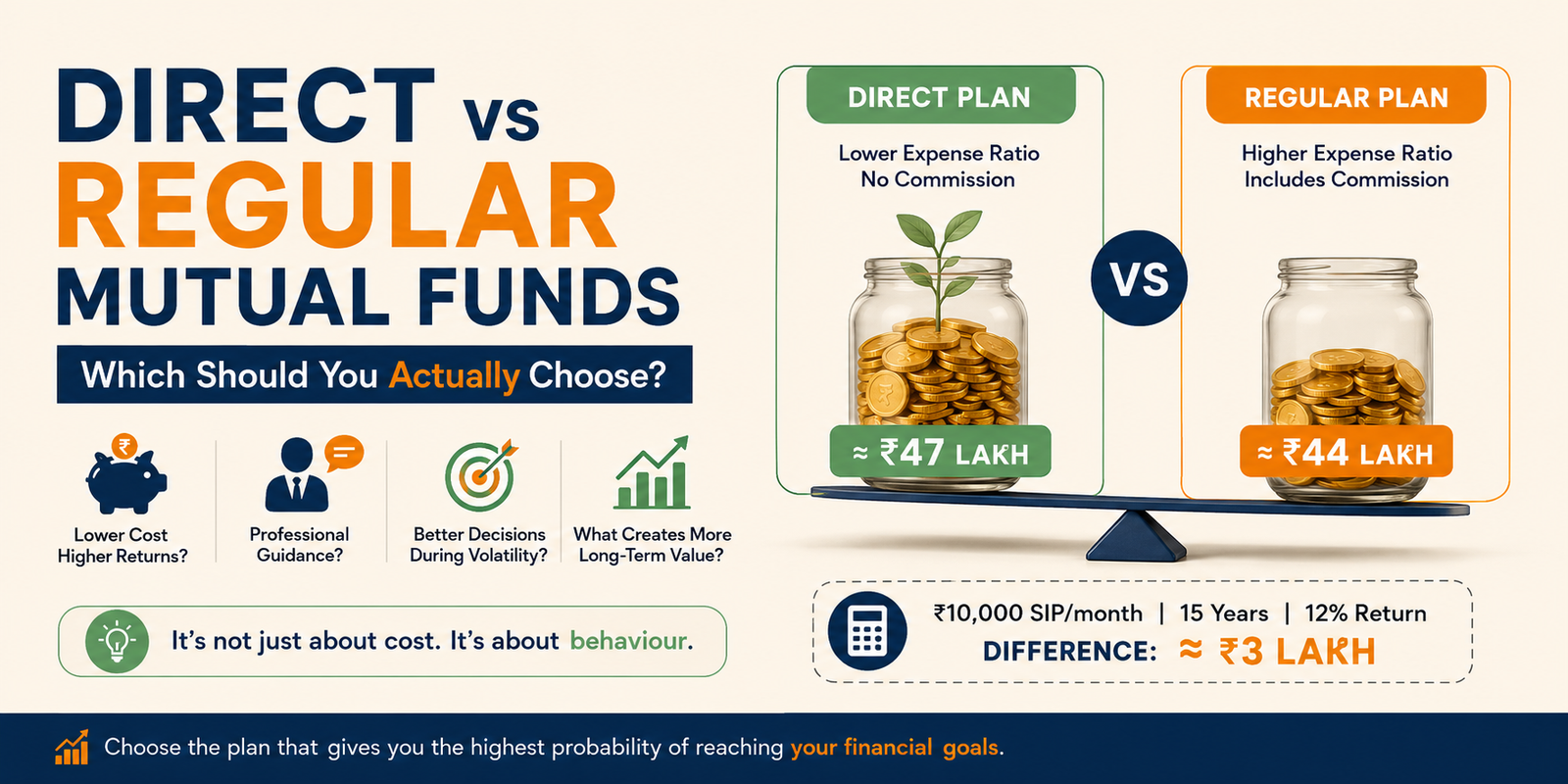
Understanding the Difference
The simplest way to understand Direct and Regular plans is this:
Direct Plan
A Direct Plan is purchased directly from the Asset Management Company (AMC). Since there is no distributor involved, there is no commission component included in the expense ratio.
Regular Plan
A Regular Plan is purchased through a distributor or advisor. The distributor receives a trail commission from the AMC, and that commission forms part of the expense ratio.
Importantly, the underlying portfolio remains exactly the same.
If a mutual fund owns Reliance, HDFC Bank, Infosys, and TCS, both Direct and Regular investors own those same stocks in the same proportions.
The difference is not the portfolio.
The difference is the cost.
What Is Expense Ratio?
Many investors assume the expense ratio is a one-time fee charged when they invest.
It is not.
An expense ratio is an annual charge deducted from the fund’s assets to cover fund management, operations, administration, and distribution expenses.
Think of it as the annual maintenance cost of running the mutual fund.
A Direct Plan excludes distributor commissions, so its expense ratio is lower.
A Regular Plan includes distributor commissions, so its expense ratio is higher.
The difference may seem small today, but compounding magnifies everything over time.
How Much Difference Are We Really Talking About?
Let’s assume:
- SIP: ₹10,000 per month
- Investment Period: 15 years
- Gross Portfolio Return: 12% annually
- Direct Plan Expense Ratio: 0.75%
- Regular Plan Expense Ratio: 1.50%
This creates a return difference of roughly 0.75% annually.
At the end of 15 years:
- Direct Plan Corpus ≈ ₹47 lakh
- Regular Plan Corpus ≈ ₹44 lakh
Difference: Around ₹3 lakh
Increase the SIP amount or extend the investment period to 20 years and the gap becomes even larger.
This is why cost-conscious investors strongly prefer Direct Plans.
The commission may look small every year.
Compounding ensures it never stays small.
Direct vs Regular Plans: Side-by-Side Comparison
Before deciding which option is right for you, let’s compare them side by side.
| Feature | Direct Plan | Regular Plan |
|---|---|---|
| Purchase Route | Directly from the AMC | Through a Distributor / Advisor |
| Expense Ratio | Lower | Higher |
| Distributor Commission | No | Yes |
| Long-Term Returns | Slightly Higher | Slightly Lower |
| Fund Selection | Investor chooses funds | Advisor assists with fund selection |
| Goal Planning | Self-managed | Advisor support available |
| Portfolio Reviews | Self-managed | Usually provided |
| Asset Allocation Guidance | Self-managed | Advisor-assisted |
| Behavioural Coaching | No | Yes |
| Support During Market Corrections | None | Advisor can help avoid emotional decisions |
| Research Required | Higher | Lower |
| Time Commitment | Higher | Lower |
| Convenience | Moderate | High |
| Best Suited For | DIY investors | Investors seeking guidance |
Pros and Cons at a Glance
| Direct Plan | Regular Plan |
|---|---|
| ✅ Lower expense ratio | ✅ Professional guidance |
| ✅ Higher long-term corpus potential | ✅ Goal-based planning |
| ✅ Complete control over investments | ✅ Portfolio reviews and monitoring |
| ✅ No distributor commission | ✅ Behavioural coaching during market volatility |
| ❌ No advisor support | ❌ Higher expense ratio |
| ❌ Requires research and monitoring | ❌ Slightly lower long-term returns |
| ❌ Easy to make emotional mistakes | ❌ Quality depends on advisor |
| ❌ Must review and rebalance yourself | ❌ Paying for services you may not fully utilize |
At first glance, Direct Plans appear to be the obvious winner because of lower costs.
However, investing success is not determined only by expense ratios.
Investor behaviour plays an equally important role.
Why Direct Plans Are Not Automatically Better
In my previous article, SIP vs Lumpsum — What Actually Works for a Salaried Indian Investor, I discussed how investor behaviour often matters more than investment strategy.
In another article, 5 Mistakes First-Time Mutual Fund Investors Make, we looked at how investors frequently:
- Stop SIPs during corrections
- Chase last year’s top-performing fund
- Wait endlessly for the perfect entry point
- Invest without a clear goal
A lower expense ratio cannot protect you from any of those mistakes.
That is where the real Direct vs Regular debate begins.
The question is not:
“Which plan gives higher returns?”
The question is:
“Which plan gives me the highest probability of staying invested long enough to earn those returns?”
Real-Life Examples: When Advice Helps and When Discipline Matters
One of the biggest mistakes investors make is comparing Direct and Regular plans only through the lens of expense ratios.
Behaviour matters too.
Story 1: When Advice Paid for Itself
During the COVID market crash in 2020, I received multiple calls from investors who wanted to redeem their portfolios.
Markets were falling every day.
News channels were predicting economic disaster.
One investor was convinced that another major crash was inevitable. He wanted to exit completely and move everything into fixed deposits.
Instead of redeeming, we spent nearly an hour discussing his goals, emergency fund, and investment horizon.
He stayed invested.
Within the following recovery cycle, his portfolio not only recovered but moved substantially higher.
The value I added was not stock selection.
The value was preventing an emotional decision.
That single conversation probably created more value than years of commissions.
Story 2: When a Direct Investor Tried to Time the Market
To be fair, not every investor needs an advisor.
I have also seen investors choose Direct Plans and do extremely well because they were disciplined enough to stick to their strategy.
However, discipline is the key requirement.
I remember one investor who managed his own Direct Plan portfolio. During a period of market volatility, he became convinced that a major correction was around the corner. He stopped his SIPs and redeemed a portion of his equity investments, planning to reinvest after the market fell further.
The correction never arrived in the way he expected.
Markets remained volatile for a few months but did not decline significantly. Eventually, they resumed their upward trend.
After watching the recovery from the sidelines, he restarted his SIPs and reinvested the money he had withdrawn. But by then, prices were higher.
His mutual funds were not the problem.
His market timing was.
The biggest loss was not the temporary cash position. It was missing several months of SIP investments during a period when rupee cost averaging could have worked in his favour.
Ironically, the same investor later admitted that if he had simply continued his SIPs without interruption, he would likely have been better off.
This is an important point that often gets missed in Direct vs Regular discussions.
Direct Plans save money through lower costs.
But those savings only matter if the investor remains disciplined.
If lower costs encourage better long-term investing behaviour, Direct Plans can be an excellent choice. If an investor frequently reacts to headlines, attempts to time markets, or struggles to stay invested during uncertainty, the savings from a lower expense ratio can quickly be overshadowed by poor decisions.
When Direct Plans Make Sense
Direct Plans may be suitable if:
- You understand mutual funds.
- You enjoy researching investments.
- You review your portfolio regularly.
- You can stay calm during market crashes.
- You do not need external accountability.
- You are comfortable making your own decisions.
For disciplined investors, Direct Plans are often an excellent choice.
There is no reason to pay for services you genuinely do not need.
When Regular Plans Make Sense
Regular Plans may be suitable if:
- You need guidance during market volatility.
- You want help with fund selection.
- You want goal-based financial planning.
- You do not have time to monitor investments.
- You value periodic portfolio reviews.
- You benefit from accountability.
Many investors do not need help choosing funds.
They need help staying invested.
That distinction is often overlooked.
A Simple Decision Framework
Ask yourself four questions:
1. If markets fall 30%, will I stay invested without needing advice?
2. Do I review my portfolio at least once every year?
3. Can I confidently select funds without relying on rankings, social media, or YouTube recommendations?
4. Do I have the time and interest required to manage my own investments?
If most of your answers are “Yes,” Direct Plans may suit you.
If most of your answers are “No,” Regular Plans may be worth considering.
Final Verdict
Direct Plans are cheaper.
That is a fact.
For disciplined investors who enjoy managing their own portfolios, they are often an excellent choice.
Regular Plans are more expensive.
That is also a fact.
But for investors who need guidance, reviews, accountability, and behavioural support, a good advisor can create value that far exceeds the additional cost.
The smartest decision is not choosing the cheapest option.
It is choosing the option that gives you the highest probability of reaching your financial goals.
Some investors save money through Direct Plans.
Others save themselves from costly mistakes through good advice.
Neither option is universally better.
The right choice depends on your knowledge, discipline, available time, and willingness to manage your own investments.
If you’d like to compare Direct and Regular plans using your own SIP amount, try the SIP calculator on AnantLabdhi.
And if you would like a human in the loop for portfolio reviews, asset allocation, and behavioural guidance, that is exactly what I do as an AMFI-registered Mutual Fund Distributor (ARN Holder).
I offer a free 30-minute portfolio review for investors who want a second opinion on their mutual fund portfolio.